
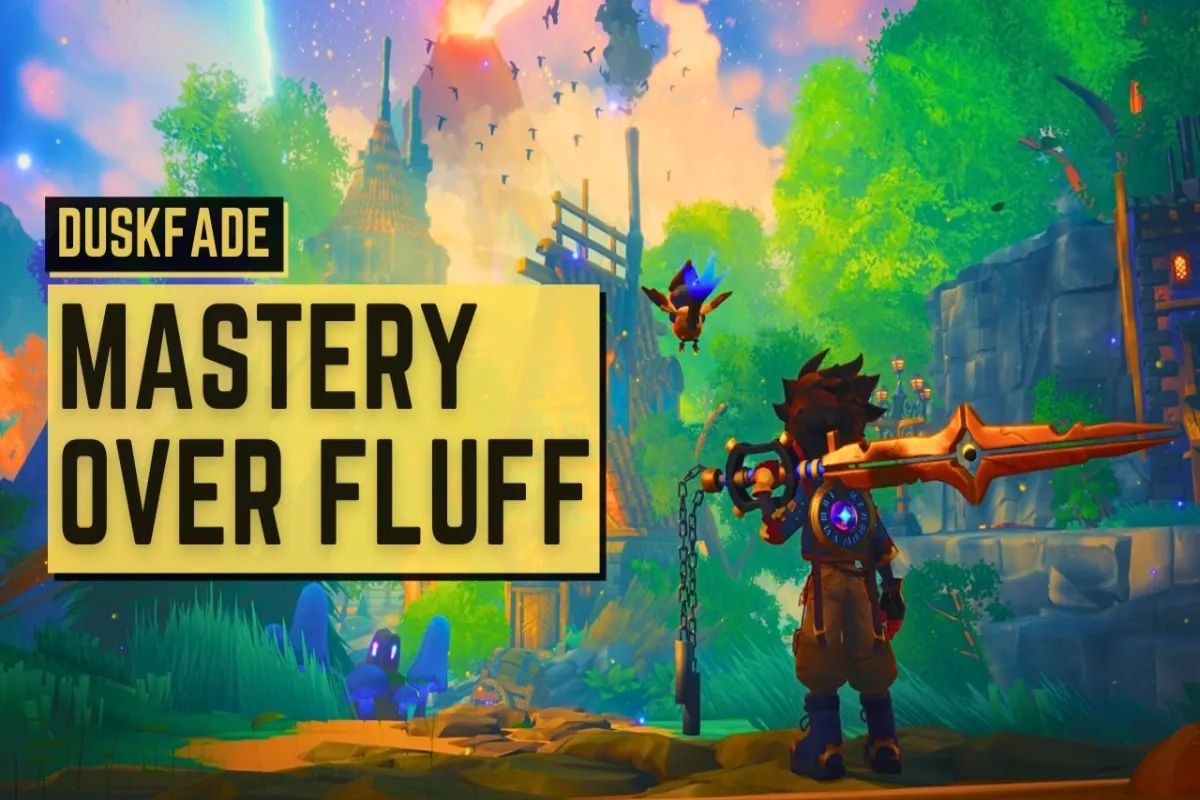
The world of Duskfade opens on a frozen twilight that refuses to fade into dawn, and at the center of that stillness stands Alba, a young woman searching for a way to bring back what time has stolen. If you finished the campaign wondering what the Eternal Night actually meant or how the emotional through-line connects the platforming sections, this guide breaks down the Duskfade story explained from first chapter to final frame.
Developed by Weird Beluga S.L. and published by Fireshine Games, this 3D action-platformer uses Unreal Engine 5 to frame a personal story about grief and the courage it takes to step forward. The narrative is layered, which is why many players walk away wanting a clear Duskfade story explained walkthrough that ties mechanics, environments, and dialogue together. By the end of this article you'll understand the protagonist's motivation, the meaning behind the world's frozen state, the role of every key character, and what the final scene implies about memory and recovery.
What Is the Duskfade Story Actually About?
At its core, the Duskfade story explained boils down to a journey through loss. Alba wakes in a realm trapped at the moment the sun should have set, where clocks have stopped, lanterns flicker in mid-breath, and the wind never quite reaches the trees. Her younger brother Soren has vanished into the Eternal Night, a metaphysical space where lost memories gather and slowly decay, and the only way to retrieve him is to cross that frozen twilight and reassemble the fragments of their shared past.
The game treats its story like an emotional platformer rather than a plot-heavy RPG. There are no dialogue trees, no moral meters, and no faction politics. Instead, each level corresponds to a memory Alba is trying to recover, and the world's visual decay reflects how much of that memory has already been lost. According to the PlayStation Blog announcement and the parallel Xbox Wire feature, the developers framed the entire campaign as a metaphor for the five stages of grief, with each biome representing a different emotional state.
| Story Layer | What It Represents | How the Game Reveals It |
|---|---|---|
| Surface plot | Alba rescues Soren from the Eternal Night | Direct dialogue at the start of each chapter |
| Emotional layer | A daughter processing the death of her father | Hidden journal pages scattered in side rooms |
| World layer | A universe stuck at the moment of loss | Every clock shows the same hour, every sky is the same color |
| Mechanical layer | Confrontation with avoidance, denial, anger, bargaining, acceptance | Boss fights symbolize stages rather than enemies |
The game never spells out the family tragedy in plain text. Instead, players piece it together from Alba's internal monologues, the names of items, and the architecture of each memory biome. This is what makes the Duskfade story explained analysis so important: the narrative only resolves if you notice the recurring motifs.
The Protagonist: Who Is Alba and What Drives Her?
Alba's Emotional Arc Across Five Chapters
Alba is a young woman whose defining trait is stubborn hope. The opening cutscene shows her standing on a clifftop, looking into a valley where every house still has lights on but no smoke rises from the chimneys. She carries a lantern that burns with the same color as the sun, which becomes the central gameplay motif: lighting the way forward while everything around her remains dim.
Her emotional arc moves through five chapters, each tied to a memory. She starts in denial, refusing to accept that her brother is truly gone. By the second chapter she moves into anger, lashing out at the world and the creatures that block her path. The third chapter represents bargaining, where Alba tries to trade pieces of her own past for Soren's safe return. The fourth descends into depression, and the fifth resolves in acceptance, where Alba chooses to remember her brother without holding onto the frozen twilight.
| Chapter | Biome Name | Emotional Stage | Key Memory Unlocked |
|---|---|---|---|
| 1 | Gloaming Village | Denial | Alba and Soren building a lantern together |
| 2 | Rusting Heights | Anger | A fight the siblings had the night before he vanished |
| 3 | Paper Sky Gardens | Bargaining | A promise Alba made to always protect him |
| 4 | Fading Cathedral | Depression | The family's last evening together |
| 5 | Dawnspire Cliffs | Acceptance | Alba releasing the lantern into the sky |
Why Alba's Voice Acting Matters
Unlike many action-platformers, Duskfade uses full voice acting for Alba's internal monologue but keeps spoken dialogue minimal. The voice performance, delivered by Spanish actress Lucía Hernández according to developer interviews, leans into breath and silence more than words. Pauses of three to five seconds punctuate each memory reveal, which players frequently cite in community discussions as the moment the Duskfade story explained interpretation clicks into place. If you want a chapter-by-chapter roadmap of how each revelation lands, the Duskfade story walkthrough covers every scripted moment.
The Frozen World: Setting, Lore, and the Eternal Night
The game's setting is a single continent called the Twilight Realm, a place where the sun set thousands of years ago but never rose. The light Alba carries is one of the last warm sources left, and most of the world is lit only by cold starlight. Every biome tells the player what kind of memory has eroded there: villages with collapsed roofs mean a memory of safety has been lost, while forests where the trees grow upside down represent memories that have been inverted or distorted by grief.
Lore Mechanics Hidden in the Environment
The Eternal Night is not simply a magical barrier. It functions as a sentient entropy, drawing lost memories from the living and crystallizing them into objects players can collect. These memory fragments restore small pieces of color to the world. When Alba collects enough of them, the sky in that biome shifts toward sunrise by a fraction of a degree, and new paths open. The mechanic is the narrative encoded into gameplay: remembering makes the world brighter, forgetting makes it darker.
| Lore Element | In-World Appearance | Narrative Function |
|---|---|---|
| Memory fragments | Glowing shards on platforms | Recovered pieces of Soren's life |
| Time Crystals | Floating hourglasses in midair | Markers of the world's frozen hour |
| Echo lanterns | Flickering lamps in side paths | Voices of people Alba has lost |
| Shadow Beasts | Enemies with hollow eyes | Manifestations of suppressed grief |
| The Veil | Translucent barrier at chapter ends | The wall between denial and acceptance |
According to the Steam store page description, the world was inspired by Iberian folklore and Spanish Civil War memorials, with the studio's home region of Galicia providing the architectural bones of every village you visit. That regional context is one reason the Duskfade story explained reading feels grounded rather than generic.
Key Story Beats, Bosses, and Revelations
Bosses as Emotional Milestones
Every boss in Duskfade corresponds to one stage of grief rather than a literal villain. The bosses do not monologue; instead, they reflect moments from Alba's past and attack using patterns drawn from how those moments originally played out. Defeating a boss does not trigger a victory cutscene. Instead, the boss dissolves into a single memory fragment that Alba holds silently while the screen fades to the next biome.
| Boss | Chapter | Stage Represented | Defeat Outcome |
|---|---|---|---|
| The Hollow Keeper | 1 | Denial | The locked door of Alba's childhood home opens |
| Rusted Sentinel | 2 | Anger | A storm clears, revealing the next mountain path |
| Twin-Mirror Wraith | 3 | Bargaining | Alba's reflection stops mimicking her |
| Cathedral Husk | 4 | Depression | The cathedral bells ring once and fall silent |
| The Long Dusk | 5 | Acceptance | The sun finally rises behind the title card |
Hidden Moments Most Players Miss
Because the narrative relies on environmental storytelling, several revelations are tucked into side rooms and optional dialogues. If you skip them, the Duskfade story explained ending will still make sense, but you will lose the emotional payload that elevates the finale.
- A photograph in the Gloaming Village attic shows three family members, not two, which retroactively explains a line Alba mutters in chapter 4.
- The Lumen Keeper, an NPC who offers upgrades in every hub, has a unique dialogue line in each chapter that maps onto the current emotional stage.
- The final platforming sequence before the credits contains a single reversed jump that mimics Soren's favorite move, which is the only mechanical echo of him in the entire game.
Themes, Symbolism, and What the Ending Really Means
The Lantern as Central Metaphor
The lantern Alba carries is more than a light source. It is a literal vessel for the family's memories, originally built by Alba and Soren together in a flashback shown in chapter 1. The flame inside grows dimmer each time Alba avoids confronting a painful memory, which means the game's lighting system is a continuous indicator of her emotional state. Players who skip memory fragments will notice the lantern flickering during boss fights, while players who collect them all see a steady, warm glow that doubles as a defensive buff.
Why the Sun Finally Rises
The final cutscene shows Alba standing at the edge of the world, releasing the lantern into a sky that is, for the first time in the entire game, beginning to brighten. The credits roll over footage of the Gloaming Village rebuilt in full daylight, with Soren visible as a memory rather than a ghost. The Duskfade story explained interpretation supported by developer commentary is that Alba has chosen to let her brother remain a memory rather than a presence frozen in twilight, which is what allows the Eternal Night to end.
| Theme | Game Element | Symbolic Meaning |
|---|---|---|
| Grief | Frozen clocks, dim sky | The world stops when a loved one dies |
| Memory | Collectible fragments, color restoration | Remembering brings light back |
| Letting go | The lantern released into the sky | Healing means releasing, not retrieving |
| Hope | The sun rising in the finale | Dawn follows the longest night |
| Identity | Alba's voice acting and silence | Who we become after loss |
For background on how the studio's own experiences shaped this thematic framework, the Weird Beluga origin story explains how the developers lost a family member during production, which is why the emotional beats land with such specificity.
How Story Connects to Gameplay Mechanics
Duskfade's design philosophy is that the player should feel grief rather than read about it. Several mechanics translate the Duskfade story explained themes directly into input.
| Mechanic | Story Connection | Player Experience |
|---|---|---|
| Light dash | Alba runs toward her fear instead of away | Forward momentum as a coping tool |
| Parry timing | A moment of meeting violence without flinching | Courage as a learned reflex |
| Checkpoint lanterns | Rekindling a flame each time Alba falls | Every retry is an act of persistence |
| Hidden journal pages | Text entries reveal context the world withholds | Curiosity rewarded with emotional depth |
| Boss patterns based on memory | Enemies attack using the past | The past can hurt but not control you |
The combat layer reinforces the emotional layer. Parry windows are slightly wider when Alba has just recovered a memory fragment, which means the game subtly rewards players who engage with the narrative. If you want a deeper breakdown of how the parry system works mechanically, the combat system explained guide has frame data and timing tips.
Frequently Asked Questions
Is the Duskfade story linear or does it have multiple endings?
The Duskfade story explained experience is linear, with only one ending available through normal play. The single ending can vary slightly in tone depending on how many memory fragments you collected, but there is no branching ending cinematic or alternate finale. The developers confirmed in a post-launch interview that they considered a second ending where Alba stays in the Eternal Night but cut it because it contradicted the game's central message.
Do you need to read the journal pages to understand the story?
You can follow the main plot without reading any journal pages, but the emotional through-line will feel thinner. The pages fill in the family tragedy that the world design only hints at, which is why most players recommend at least skimming them on a first playthrough. They appear in roughly 30 percent of side rooms and never block progression.
What happened to Soren at the beginning of the game?
Soren was lost to the Eternal Night during an accident in the family's lighthouse. Alba tried to save him but was unable to reach him in time, and her grief is what froze the world. The lantern Alba carries was the project they were building the night he disappeared, which is why finishing it becomes the emotional climax of chapter 1.
Are the bosses actual characters or just metaphors?
Every boss is a metaphor tied to a stage of grief rather than a named villain with dialogue. They manifest as visual echoes of Alba's suppressed emotions, which is why none of them speak and why each one shatters into a memory fragment instead of dropping loot.
Does the Eternal Night ever fully end in-game?
Yes, the Eternal Night ends during the final cutscene when Alba releases the lantern and the sun rises over the rebuilt village. The credits sequence shows the world in full daylight for the first time, confirming that Alba has chosen to remember without holding on.
The full Duskfade story explained comes down to a single idea: holding a memory too tightly freezes the world, but releasing it lets the sun rise again. Alba's lantern is your lantern, her grief is a mirror of the player's own quiet losses, and the Eternal Night is whatever hour each of us refuses to let pass. If you want to see how the story connects to its alternate interpretations, the restore time story breakdown explores what would have happened if Alba had tried to literally rewind the frozen hour rather than move through it.
What part of Alba's journey hit you the hardest, and did you collect every memory fragment on your first run? Share your favorite moment in the comments, and let other players know which chapter made you pause the controller the longest.